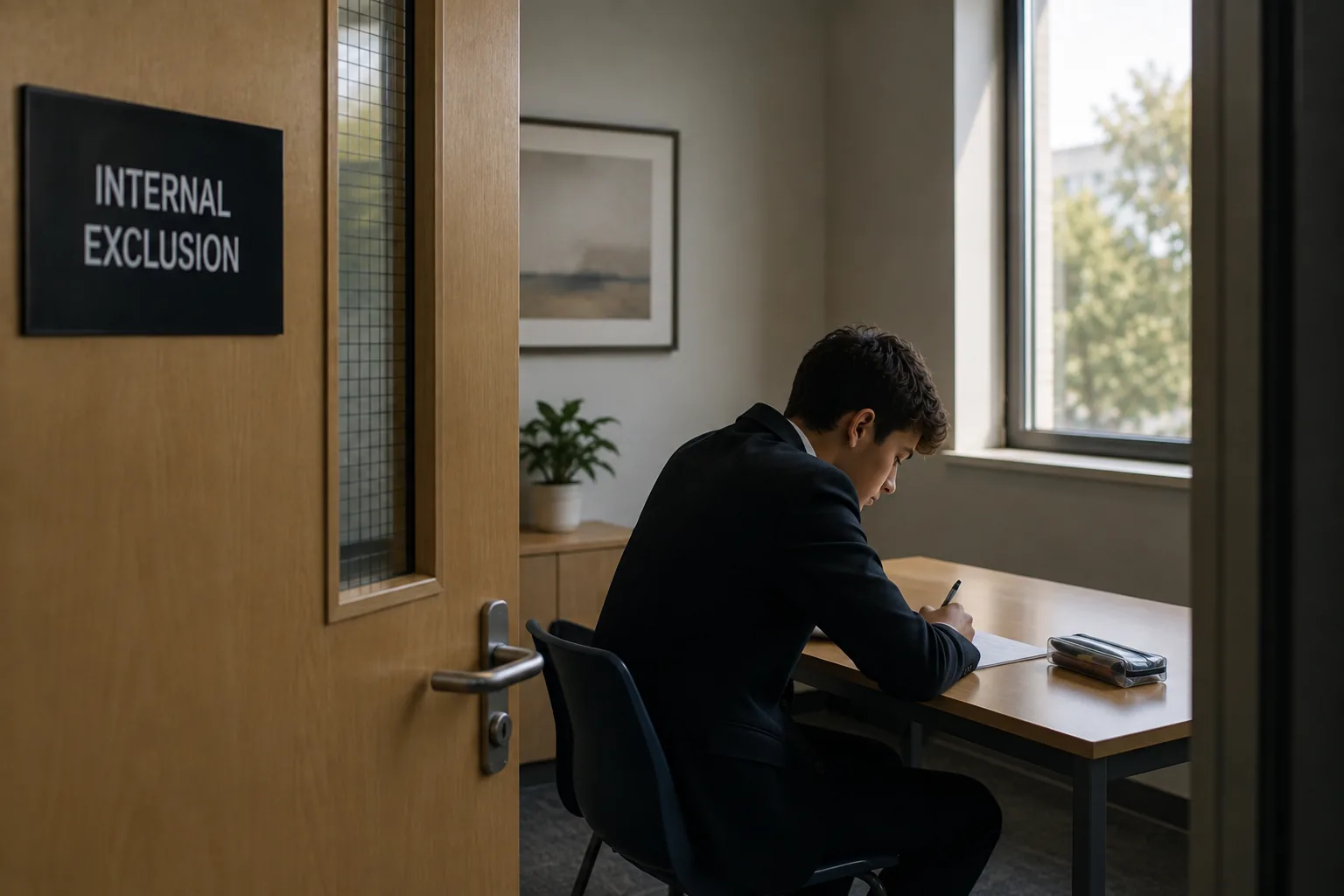
Last year, 22% of disadvantaged pupils in English secondary schools were removed from lessons and placed in internal exclusion at least once. Three years earlier the figure was 8%. For pupils who are not disadvantaged it was 10%; for pupils with an education, health and care plan, 18%. Across all secondary pupils, the rate rose from 5% in 2022/23 to 13% in 2025/26. Over the same year, the official figures published by the Department for Education showed suspensions and permanent exclusions going down.[1]
The figures come from an analysis reported by the Guardian on 3 September, drawn from the live records of a school management system used by 13,000 schools in England. That provenance is the story. The government collects data on suspensions and permanent exclusions, and publishes it. It collects nothing on internal exclusion – the removal of a child from their normal lessons to a room elsewhere in the building, for a period, before they are returned. So the only national picture of a practice affecting one in eight secondary pupils had to be assembled from the systems schools use to run themselves, by the company that runs one of them.[1]
What the numbers can and cannot say
The analysts themselves are careful about what the divergence means. Suspensions fell and internal exclusions rose, but the data cannot show whether one is replacing the other; it can only show that the official picture is incomplete. The Education Policy Institute’s researcher put it plainly: classroom removal has become a deeply embedded feature of behaviour management in England’s secondary schools, and removed pupils should have the same legal protections and transparency that apply elsewhere. The Children’s Commissioner raised a second question – whether children in internal exclusion are actually receiving a high-quality education while they are there.
The practice has serious defenders, and their case is worth stating in full. Tom Bennett, the government’s behaviour adviser, calls internal exclusion a form of inclusion: a child kept on site, with higher staff ratios and work done on their behaviour, is better placed than a child sent home to an empty house or worse. The Association of School and College Leaders says it is never used lightly and only after other avenues are exhausted. Both are right, and neither answers the question the data raises, which is not whether the room should exist but who ends up in it, and whether anyone knows.
The same problem at Ofsted
In the same week, Ofsted’s chief inspector told the Commons education committee that the inspectorate cannot reliably say how many schools have been marked down under its new combined “attendance and behaviour” grade for weak attendance alone, or weak behaviour alone. School leaders had asked because the coupling seemed unfair to schools strong in one and weak in the other. Unions called the answer troubling.[2]
It is the same failure at a different scale. Once two judgements are combined into a single grade, nobody can pull them apart again – not the schools being judged, and evidently not the regulator doing the judging. Internal exclusion has the problem in miniature: nobody hides the room, but nobody built the record in a form that shows who is in it. The lesson in both cases is the same. Things that need to be seen together should be held side by side, not merged – kept distinct, and visible in one view.
What it looks like in Dubai
There is no pupil premium in a Dubai school, and no free-school-meals flag to measure disadvantage by. The disadvantage is there all the same, and every pastoral lead knows its lines: the child still learning the language of instruction, the student of determination whose need has been identified but not yet formally named, the child on fee support, the child whose parents cannot make the meeting. I have seen isolation rooms in Dubai schools run by good teachers for good reasons, and I have rarely seen a system that could tell those teachers, at the end of a term, who had been in the room most and whether that group looked like the school.
KHDA’s inspection framework already asks how well a school serves its students of determination and how inclusive its provision is. A school that cannot cut its own removal log by group cannot answer that question with evidence, only with assurance.
The table
The check is small. Take the removal log for a term and cut it four ways: by identified need, by language, by fee support, by year group. Compare each group’s share of removals with its share of the school. The pattern is there in most schools that have looked, and it is almost always a surprise to the people running the room, because the room is run one child at a time and the pattern only exists in aggregate.
Any school whose behaviour system records removals as they happen can produce that table in an afternoon. The reason most schools have never seen it is not that nobody cares. It is that the record was built to log incidents, not to be read by who they happen to.
That reading is what Ten Points is for. Every removal is recorded at the moment it happens, against a student record that already carries the school’s own flags for need, language and fee support, so the table above takes minutes rather than a term. And because behaviour and wellbeing sit side by side in one view, a child who has been in the isolation room three times this half-term appears next to their journal entries and mood check-ins – the same child, seen whole, by the people who need to see them. Safeguarding concerns remain a separate record with their own access rules, as they should.
If you lead a school and would like to see what that table looks like for a school like yours, the first step is small: a conversation. Book a call.