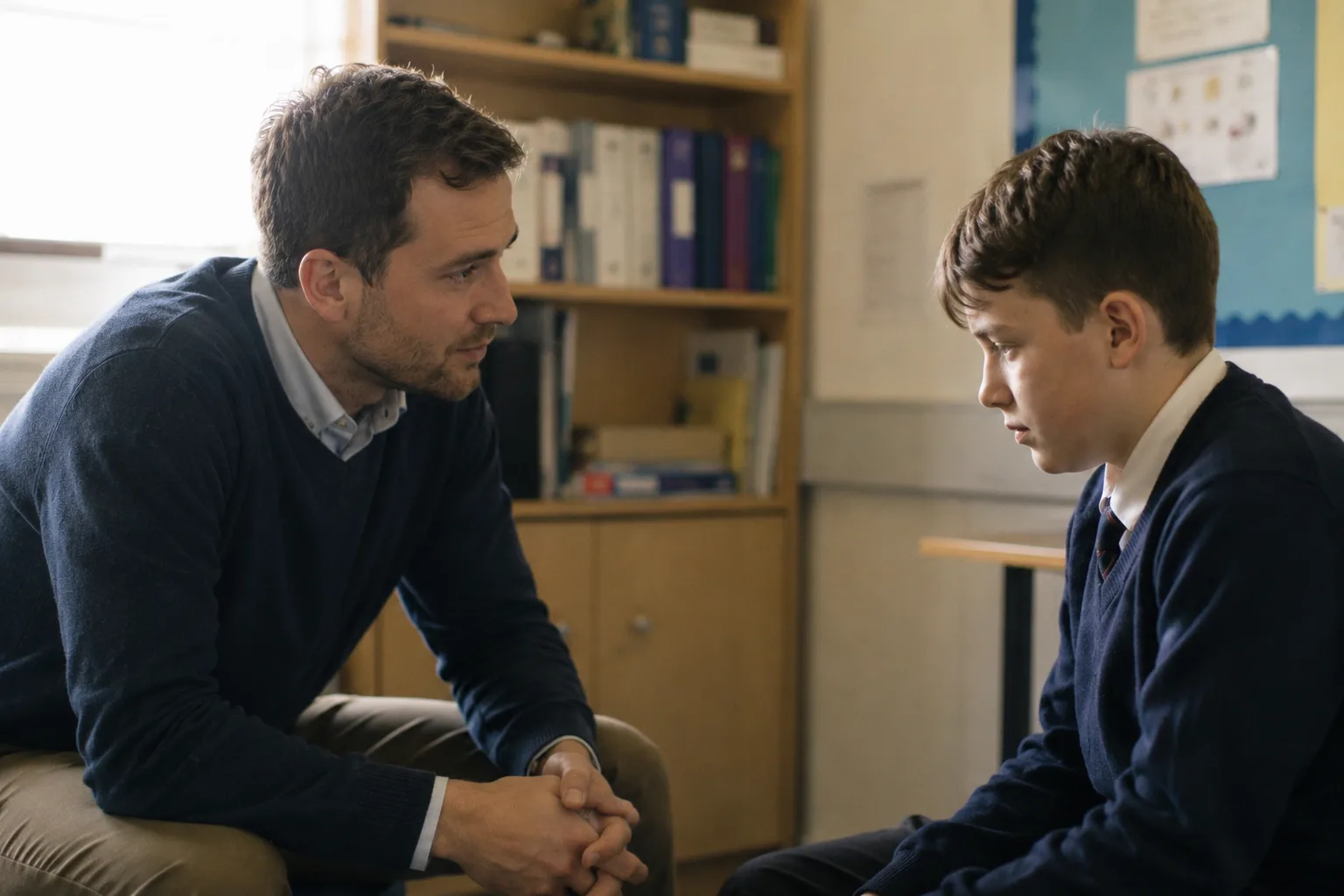
Restorative practice gets a bad rap when it’s reduced to a script taped inside a folder. Done well, it isn’t a script at all. It’s a posture. You’re not interrogating; you’re helping a child make sense of what happened so they can do better next time.
And it isn’t five conversations, either. It’s one conversation, built around five questions that – asked in order – walk a child from defensive to reflective: from “it wasn’t my fault” to “here’s what I’ll do differently.” The questions are simple. The discipline is in how you hold them.
Before the first question
The conversation starts before you open your mouth. Three things decide whether it lands:
- Privacy. Nobody reflects honestly with an audience. Find a quiet corner, not the middle of a corridor.
- Timing. A child still flooded with adrenaline can’t think, only defend. Sometimes the most restorative thing you can do is wait twenty minutes.
- Position. Sit alongside or at an angle, not squared up across a desk. Your body is part of the message: we’re working on this together; you’re not on trial.
Get those right and the questions almost ask themselves.
The five questions
1. “Tell me what happened – from the start.”
Open with curiosity, never a verdict. The fastest way to lose a child is to lead with judgement: the moment they feel accused, they stop thinking and start defending. Ask for the story, then – this is the hard part – stop talking. You’ll learn more in ninety seconds of genuine listening than in ten minutes of telling. Let the silences sit; that’s where the honesty lives.
2. “What were you thinking at the time?”
This question quietly does the most important work in the whole conversation: it separates the decision from the person. Behaviour is a choice; the child is not the choice. Asked without a trace of sarcasm, it invites them to look at their own thinking from the outside, the first muscle of self-regulation. You’re not excusing what happened; you’re helping them find the moment it turned.
3. “Who else was affected?”
Restoration is about widening the circle of empathy. Children caught up in an incident are usually locked inside their own version of it; this question gently turns them outward – to the classmate, the teacher, the friend who got caught in the middle, sometimes themselves. Don’t rush it, and don’t answer it for them. The point is for them to arrive at the harm, not to be told it.
4. “What needs to happen to put it right?”
Ownership beats punishment every time. A sanction handed down is something done to a child; a repair they propose is something they own. You may need to steer – their first offer is sometimes too small, occasionally too grand – but the words should be theirs. A modest repair that actually happens is worth more than a grand apology that never does.
5. “What will you do differently next time?”
End facing forward, not backward. The first four questions make sense of the past; this one builds a plan for the next time the same pressure shows up. Because it will. Keep it concrete and small enough to actually do: walk away and find me, ask for help before I get stuck, count to five. Vague good intentions don’t survive contact with a hard morning; a specific plan sometimes does.
Why the order matters
You can’t shortcut to question five. A child who hasn’t told their story won’t own a repair; a child who can’t yet see who was harmed has nothing to put right. The sequence is the method: understand the past (1–3), then build the future (4–5). Jump straight to “what will you do differently” and you’ll get the answer they think you want, not the one they’ll actually keep.
What to avoid
A few reliable ways to turn a restorative conversation back into a telling-off:
- Leading questions. “Don’t you think that was unkind?” isn’t a question, it’s a verdict wearing a question mark.
- Rushing to sorry. A fast apology is often a way out of the conversation rather than a way through it. Sit with the harm before you reach for the repair.
- Moralising. The lecture at the end undoes the listening at the start. If they got there themselves, let them have it.
The part nobody mentions
The conversation isn’t the end. The record is. If a child has the same conversation three weeks running and nobody connects the dots, you haven’t done restorative practice, you’ve done theatre. The fifth conversation should start where the fourth one finished, not from scratch.
Patterns are invisible in the moment and obvious in the data.
That’s exactly why we built reflection logging into Ten Points: so the next conversation can pick up the thread, and so the things that keep recurring become impossible to miss. The five questions are the craft. Remembering what they reveal – child by child, week by week – is what turns one good conversation into genuine change.